
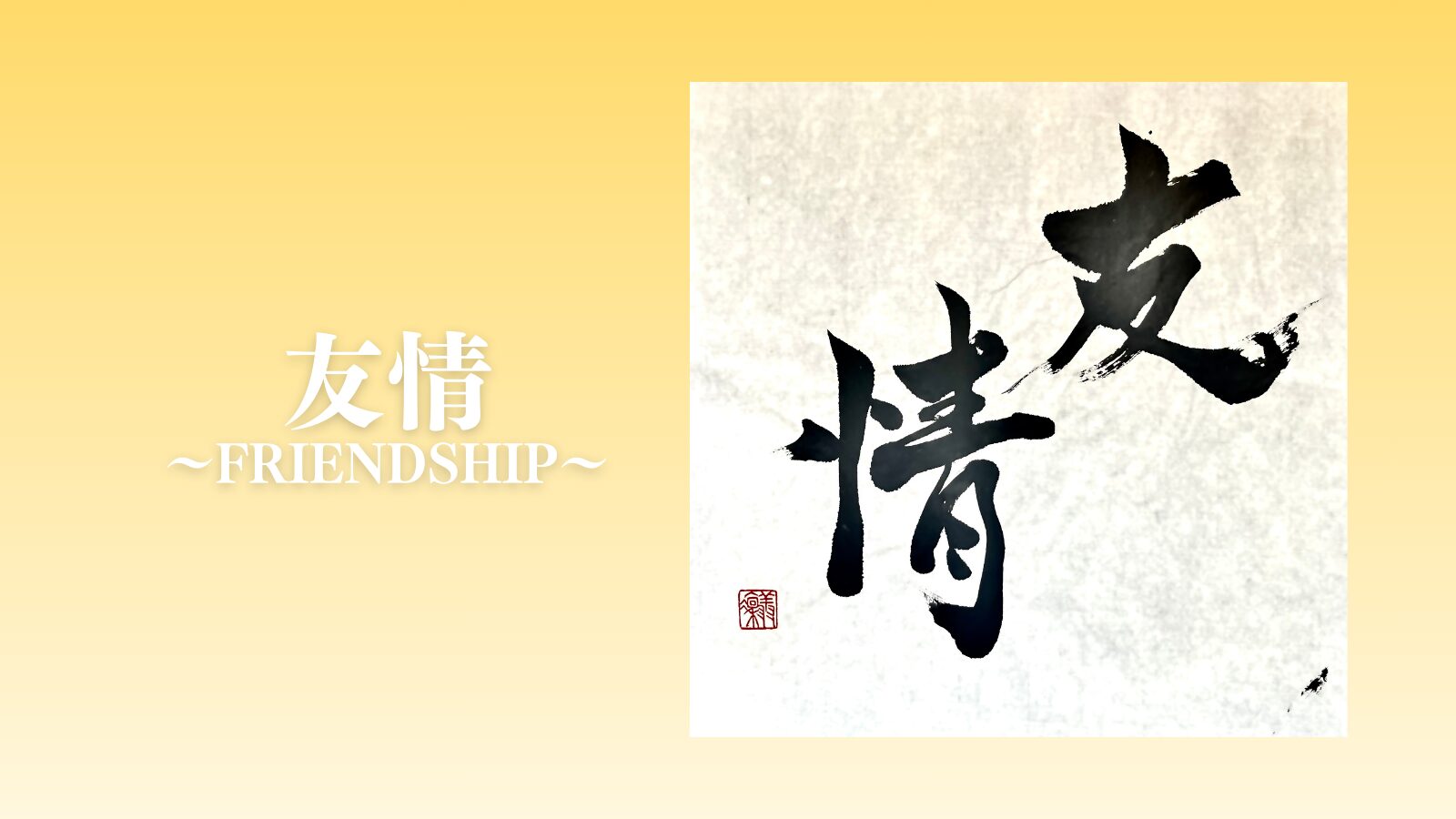
Every stroke holds a soul.
When you encounter this work, you will surely find the face of someone dear rising quietly in your mind.
\ 岩﨑翔凛のSTORESはこちら! /
The Weight of the Word “Friendship”
Friendship (友情, yūjō) is defined as the deep affection that blossoms between friends.
That is how a dictionary would describe it — yet the meaning carried by these two characters runs far deeper, far warmer, and at times far more bittersweet than any definition can hold.
Some say that when you break down the kanji 「友」(tomo, friend), you find two hands facing each other, each supporting the other.
Helping, leaning close, layering shared time — all of that human practice is compressed into this single character.
And 「情」(jō, feeling) is the movement of the heart itself.
By sharing joy, anger, sorrow, and delight, people deepen their jō — their emotional bonds — with one another.
The compound word yūjō carries a uniquely resonant sound in Japanese.
Not romantic love, not familial love, not parental love — but friendship.
It arises not from obligation or blood, but from the free choice of the heart: I want to be with this person. I want to do something for this person.
That is precisely what makes friendship so beautiful.

What the Ages Have Said About Friends
Since ancient times, people have poured the importance of friendship into poems and proverbs.
The classical literature of East Asia is rich with words that speak to the bonds between friends.
“Good medicine is bitter to the mouth; honest counsel is harsh to the ear.” The friend with whom you can truly open your heart is the most precious treasure of all. — Confucius, The School Sayings of Confucius
Confucius spoke of the 益者三友 (Ekisha San’yū) — three kinds of friends who genuinely benefit us in life: the upright friend, the sincere friend, and the learned friend.
His insight that the essence of friendship lies not in simply being together but in elevating each other has lost none of its truth across more than two thousand years.
Funkei no Majiwari (刎頸之交):A bond so deep that one would gladly lay down one’s own neck without regret.
The most profound tie that can exist between two friends. — Chinese proverb
And the phrase that speaks most powerfully to the depth of friendship in Japanese is Funkei no Majiwari — a relationship bound by trust so absolute that one would not spare even one’s own life.
Such a bond is never born overnight; it is forged slowly, tempered through the trials that time brings.
Four-Character Idioms and Proverbs of Friendship
竹馬之友 — Chikuba no Tomo Friends who grew up together from earliest childhood; a companion of many long years.
水魚之交 — Suigyo no Majiwari An intimacy as inseparable as water and fish — a bond that cannot be cut.
断金之契 — Dankin no Chigiri A pledge of friendship so strong it could cleave through metal.
莫逆之友 — Bakugyaku no Tomo A true friend with whom the heart is so open that no disagreement can arise.
What This Work Holds Within
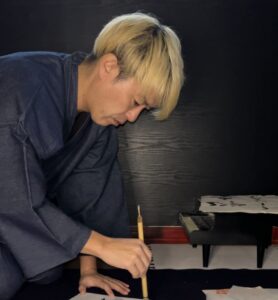
When Shourin Iwasaki set brush to paper to write this “Friendship,” the brush moved in silence — yet with unmistakable force.
The character 「友」spreads boldly across the upper right, while 「情」stands below it with a power that seems to defy gravity.
The two characters hold a perfect tension between them, composing a scene that feels almost like two people standing side by side, shoulder to shoulder.
Within the flowing brushwork characteristic of cursive script (sōsho), fine traces of kasure — a deliberate dryness where the ink thins — take up residence.
This is not a flaw.
It is a necessity.
Within the kasure lives breath.
Lives feeling.
It is in the precise moment where white and black cross, Shourin says, that the soul of calligraphy truly dwells — not in perfectly saturated black.
A friend is someone with whom even silence becomes conversation. Like the gradations of ink — neither too close, nor too far. It is in that space between that feeling overflows. — Shourin Iwasaki, from his studio notes
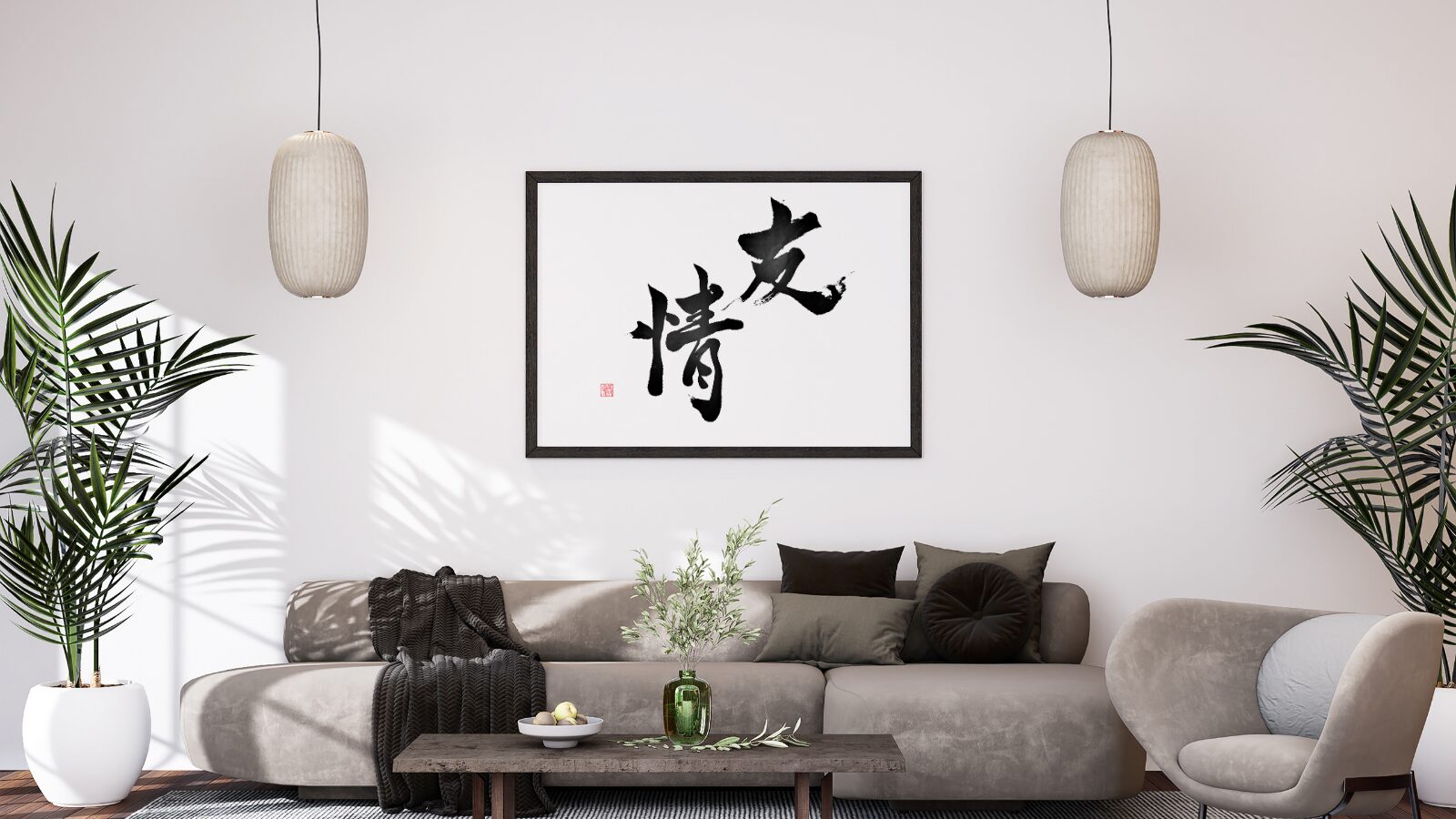
When you hang this work on your wall, you may find that every time you pass it each day, the face of a beloved friend far away quietly surfaces in your mind.
A work of calligraphy speaks to a space. It changes the air of a room — gently, yet with certainty.
That is the power of true shodo.
About Calligrapher Shourin Iwasaki
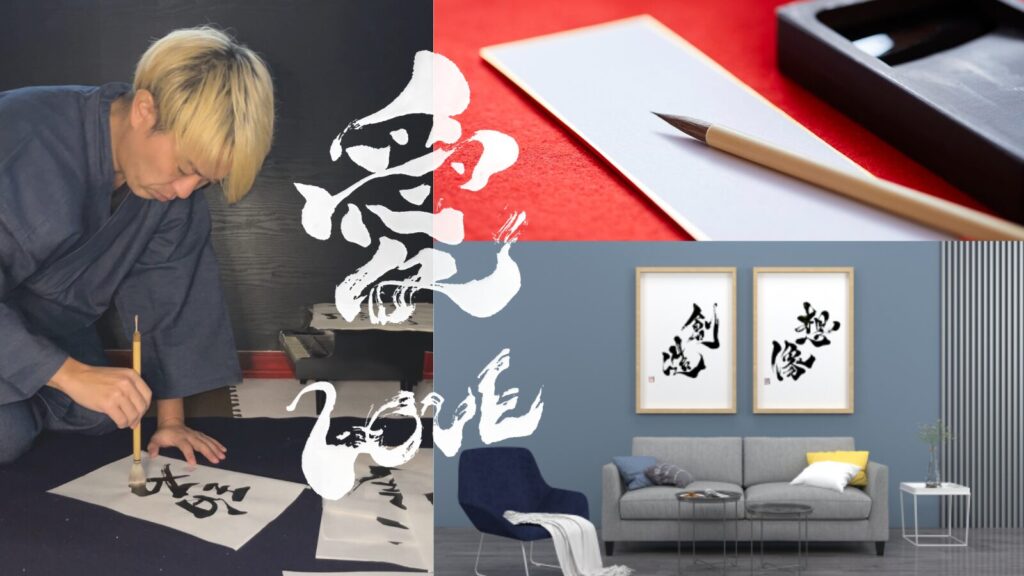
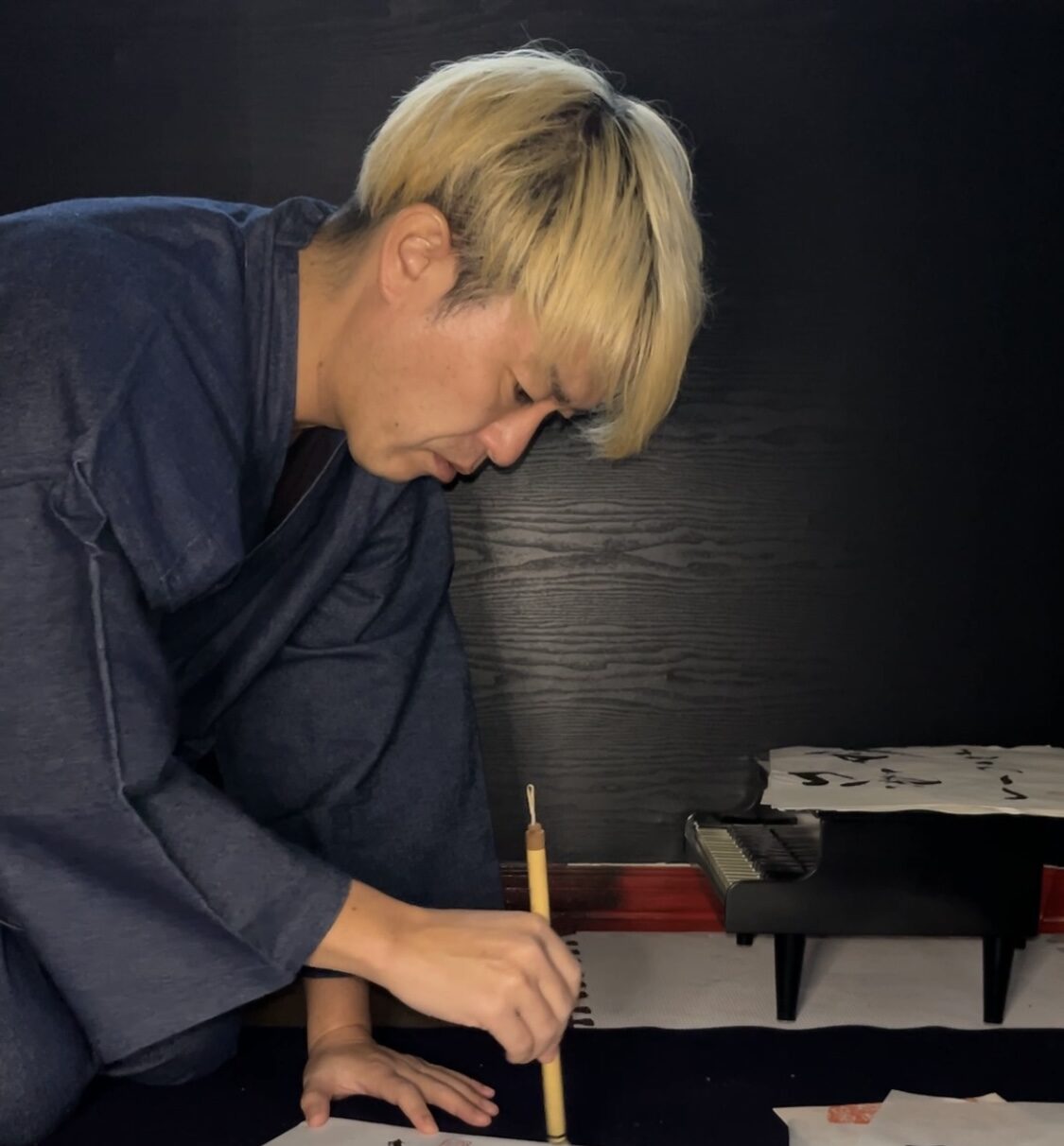
Shourin Iwasaki is a calligrapher who continues to explore new possibilities for the art of shodo through a contemporary sensibility, while faithfully inheriting the essence of Japan’s traditional calligraphic heritage.
Grounded in the solid technique cultivated through years of copying classical masterworks, he holds it as his creed to breathe a story into every single piece he creates.
“I do not write characters — I write feelings.”
True to those words, there is something in Shourin’s work that moves the heart of every person who stands before it.
It is not born from technique alone; it is the result of the calligrapher’s own life experience and sensitivity dissolving into the ink.
On Instagram, he shares not only finished works but also the process of creation and his daily reflections.
The trial and error behind the birth of a single piece, the quiet dialogue between brush, ink, and paper — all of it forms the world of Shourin Iwasaki’s calligraphy.
On Shourin Iwasaki’s Instagram, works like this “Friendship” are shared every day.
Completed pieces, of course — but also the moments of creation, the very breath of the brush in motion.
Follow along and bring the world of shodo into your daily life.
\ 岩﨑翔凛のInstagramはこちら! /
Bring a Work by Shourin Iwasaki Into Your Space — Online Shop NOW OPEN

Shourin Iwasaki’s calligraphy art shop has now opened on STORES.
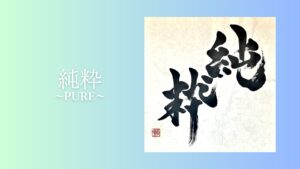
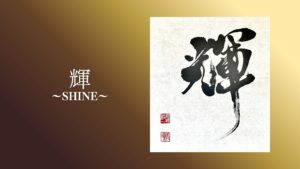
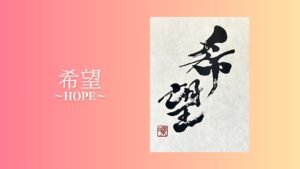
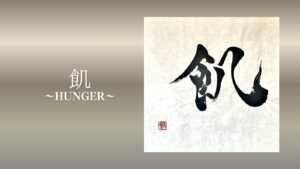
Alongside “Friendship,” the shop offers works written with cherished words such as love, dream, bond, and ichi-go ichi-e (once in a lifetime).
Frame one and hang it in your home, and it will bring a quiet, crisp air to the rhythms of your everyday life.
These are genuine, one-of-a-kind calligraphy works — treasured gifts for those you love. Please take a look.
\ 岩﨑翔凛のSTORESはこちら! /
コメント